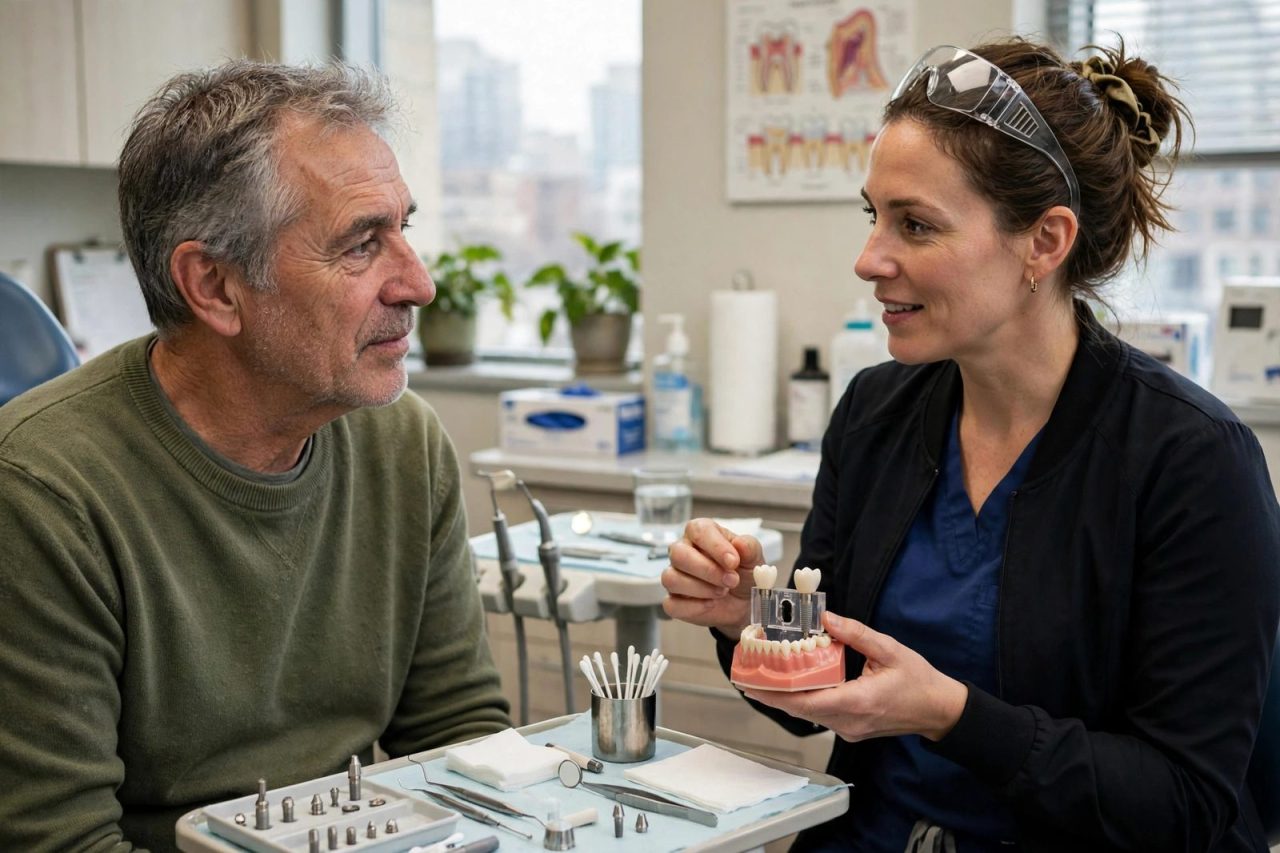
When several teeth — or all of them — are missing, the real comparison is dental implants vs dentures in Toronto. Dentures are removable teeth that rest on the gums. Implants are posts placed in the jawbone that can hold a single crown, a bridge, or even a full denture firmly in place. Many Toronto patients end up with a blend: a denture that clips onto implants. This guide compares the options honestly, including who each one does not suit.
For treatment details, start with our page on dental implants in Toronto at Yorkdale Dental Centre, then come back to the table.
On this page
The short answer
Dentures are the non-surgical, faster and simpler route to a full set of teeth, and they suit almost everyone — but they rest on the gums, move more, and chewing force is lower. Implants anchor teeth to the bone, giving the firmest bite and helping slow bone loss, but they involve surgery, a longer timeline, and they are not covered by the CDCP. An implant-supported denture sits between the two and solves the most common denture complaint: a loose lower denture.
Implants vs dentures, side by side
| Dental implants (including implant-supported dentures) | Traditional dentures | |
|---|---|---|
| What it is / how it works | Titanium posts placed in the jawbone. They can carry a crown, a bridge, or a denture that snaps onto them, so the teeth are fixed or firmly held rather than resting on the gum. | A removable set of false teeth with a gum-coloured base that sits on the gums, held by fit and suction (upper) or by the tongue and cheek muscles (lower). |
| Typical lifespan | Jung and colleagues (2012) reported 10-year survival of about 95% for single implants (survival = the implant still in place); Pjetursson and colleagues report similar 10-year survival for implant-supported restorations. An implant-supported denture itself is a removable part that wears and is replaced over time, like a regular denture. | Prosthodontic guidance commonly reports dentures needing relining as the gums and bone change shape, with replacement often discussed after roughly 5–10 years of wear. These are planning ranges, not guarantees. |
| Maintenance and care | Fixed implant teeth are brushed like natural teeth. An implant-supported denture comes out for cleaning, and its attachments are checked and serviced at check-ups. | Removed daily for cleaning and soaked overnight; gums are rested and cleaned. Adhesive helps some wearers but does not fix a worn or ill-fitting denture. |
| Effect on neighbouring teeth and jawbone | Posts load the bone where roots were lost, which helps slow the bone shrinkage that follows tooth loss. Neighbouring teeth are not used for support. | Without roots, the jawbone under a denture gradually resorbs, which is why dentures loosen over the years and need relining or replacement. |
| Who it suits and who it does not | Suits patients with enough bone (or bone that can be rebuilt) whose health allows a minor surgical procedure, and who want the firmest bite. May not suit patients whose health rules out surgery, or who want the simplest and fastest result. | Suits almost any patient missing teeth, including those who cannot have surgery. Lower dentures are the weak point — with no palate for suction, many wearers find them mobile, which is exactly the problem implants solve. |
| Number of visits and timeline | Several visits over a few months: placement, a healing period while bone bonds to the posts, then the teeth are made and fitted. | Several visits over a few weeks: impressions, bite records, a try-in, then fitting and follow-up adjustments. |
| CDCP coverage | Dental implants are not covered by the Canadian Dental Care Plan. | Dentures are a service the CDCP can cover for eligible patients, subject to the plan’s rules and preauthorization — eligibility always comes first. Federal details: Canada.ca — Canadian Dental Care Plan. |

How to choose
Start with the lower arch, where the two options differ most in daily life. Then weigh surgery and timeline honestly, and ask how your bone looks on imaging — that decides what is even possible. Factors that affect cost include how many implants, whether grafting is needed, and the type of teeth made, so an exact figure follows an assessment with Dr. Shadi Ghanaat. Call Yorkdale Dental Centre in Toronto at (416) 787-1275. The clinic is open Monday to Thursday 9–19, Friday by appointment only, Saturday 9–15, and closed Sunday; same-day emergency appointments are available on open days if you have pain or a broken denture — call ahead. Nitrous oxide (laughing gas) is available, including for children, for patients who feel anxious about treatment.
Common questions
Can a denture be attached to implants later?
Often yes. Many patients start with a conventional denture and add implants later; the denture may be adapted or remade to clip onto the implants. Planning this possibility early can simplify the later step.
How many implants does a full denture need?
It depends on the arch and the design. A lower denture can often be stabilised by as few as two implants; fixed full-arch teeth need more. Your assessment and imaging determine the number for your case.
Do implants hurt?
The procedure is done with local anaesthesia, and nitrous oxide is available at Yorkdale Dental Centre for anxious patients. Post-procedure soreness is usually managed with standard measures and settles over days; you will be given specific aftercare instructions.
Why does my lower denture move so much?
The lower denture has no palate to create suction, the tongue displaces it, and the lower ridge resorbs over time. Relining helps fit; implants address the retention problem itself.
How long do implants take from start to finish?
Typically a few months, because the bone needs time to bond to the posts before the final teeth are fitted. Temporary teeth arrangements for the healing period are planned in advance.
Can I get implants if I have worn dentures for years?
Often yes, but long-term denture wear means more bone loss, so imaging is essential. Some patients need grafting; others are better served by an implant-supported denture using the bone that remains.
What if an implant fails?
A small minority of implants do not integrate or are lost later — the survival figures in the table reflect that. If one fails, it can often be replaced after healing, or the plan adjusted to a bridge or denture solution.
Does the CDCP cover implants or dentures?
Dentures can be covered for eligible patients, subject to plan rules and preauthorization. Implants are not covered by the CDCP. Call (416) 787-1275 and we will help you check eligibility first.
Yorkdale Dental Centre, Toronto — Dr. Shadi Ghanaat — (416) 787-1275.